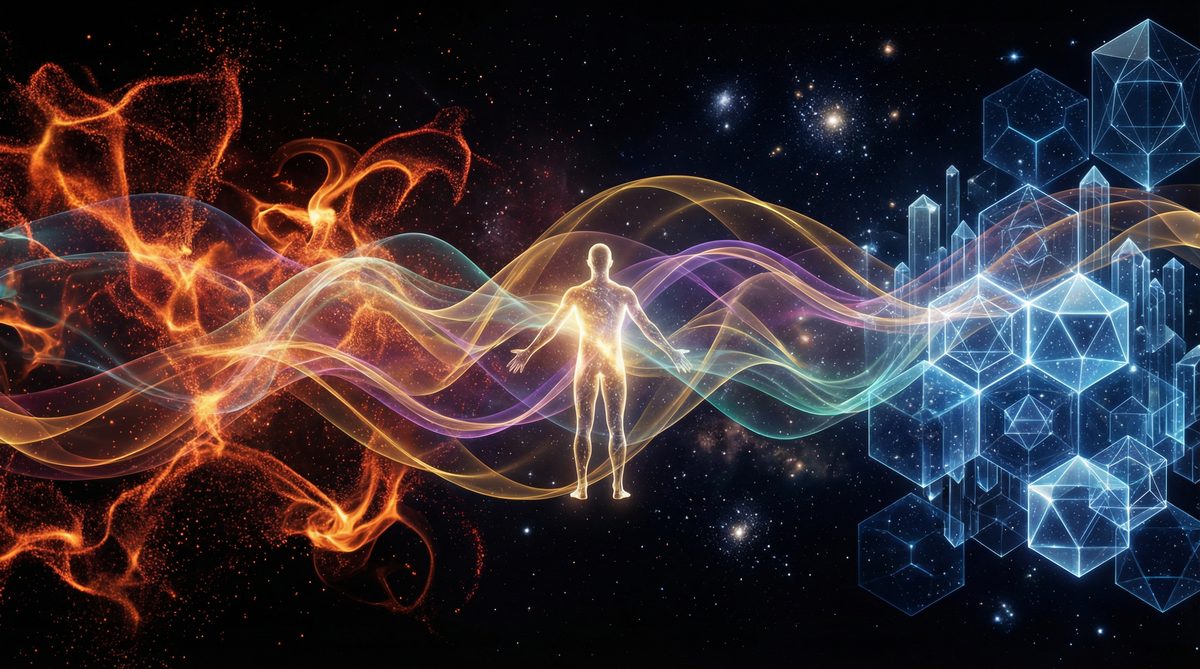
The universe has one default direction: toward chaos.
Cups shatter and don't reassemble. Iron rusts. Buildings crumble. Stars burn out. The final state of everything is heat death — uniform energy distribution, no temperature differences, no information, nothing happening ever again. That's entropy. The second law of thermodynamics says it only goes one way in an isolated system: from order to disorder.
Now look at yourself.
This morning you spent energy organizing a pile of disorganized molecules into breakfast. Then you spent more energy transporting your body to work. Then even more turning thoughts into code, documents, conversations. Everything you did today was the same thing: turning disorder into order.
It's not just you. Human civilization is an anti-entropy machine.
Life feeds on negative entropy
Erwin Schrödinger put it perfectly in What is Life?: "Life feeds on negative entropy."
Being alive means resisting entropy. You need continuous energy input (food) to maintain your body's internal order. Your body converts food's chemical energy into heat and motion, breaking low-entropy molecules into high-entropy waste. You're not "using" energy — you're buying order with it.
Human civilization is just this process scaled up.
Fire was humanity's first major energy skill tree. With fire, we stopped passively adapting to the environment and started actively reshaping it — cooking released more nutrition, lighting extended activity hours, smelting created tools. Each advancement used chemical energy to upgrade social order.
Then came fossil fuels. Coal and oil are essentially billions of years of stored solar energy buried underground. Humans spent a few centuries cashing out this "energy savings account" — steam engines, electricity, airplanes, the internet. Every energy leap brought exponential growth in civilizational complexity: global trade, instant communication, 4 billion people online.
This is not coincidence. Energy is civilization's currency. More energy = larger organizational scale = higher complexity = more order.
MIT models estimate humanity is currently at approximately Kardashev Level 0.73 — we'd need to increase energy consumption about 1,000× to reach Type I status (controlling all energy reaching Earth). At current growth rates, that's around 2371. Elon Musk put it bluntly: becoming a multi-planetary species isn't romantic idealism — it's a mathematical inevitability of energy growth. Earth's energy supply has a ceiling. For civilization to keep growing exponentially, it must find new sources.
You are Maxwell's demon
In 1867, James Clerk Maxwell proposed a thought experiment.
Imagine a box divided in half by a wall with a door, controlled by a tiny demon. This demon can see the speed of every molecule — it lets fast ones go left and slow ones go right. The result: without doing any work, one side gets hot and the other gets cold. It created temperature difference and order from equilibrium.
Does this violate the second law?
No. Because the demon needs information — it must measure each molecule's speed, and acquiring, storing, and erasing that information costs energy (Landauer's principle: erasing 1 bit of information produces at least kT ln 2 of heat). Information has a thermodynamic cost.
Humans are Maxwell's demon.
We use information (knowledge, technology, organization) to reduce local entropy. The cost is more energy consumed, more disorder created elsewhere in the system. We build cities — the cost is climate change. We train AI — the cost is skyrocketing electricity demand. Every increase in order creates equal or greater disorder somewhere else.
Is this trade worth it? From your individual perspective, absolutely — you built a company, wrote an article, raised a family. Your local entropy decreased. But from the universe's perspective, you just moved the chaos somewhere else.
The same law, every scale
This is what I find most remarkable — the energy-order law operates at every scale, from individual to organization to civilization to AI. Only the magnitude differs.
Individual: What you do every day is input energy (food, sleep, learning) → decrease internal entropy (skills, knowledge, health, wealth) → output greater disorder (waste heat, carbon emissions, time spent). A person who consistently inputs high-quality energy can build order more effectively. This is why the most successful people have intense energy management awareness — they're not just "working hard," they're efficiently acquiring and allocating energy.
Organization: A company is fundamentally an anti-entropy machine. Founders invest time, capital, relationships (all forms of energy) to organize talent and resources into products and services (ordered structures). The more successful the company, the more energy it consumes and directs. This isn't exploitation — it's thermodynamics. Musk's wealth isn't because of greed — it's because he's more efficient than most at directing energy to build order. SpaceX uses chemical energy to put humans on Mars. Tesla converts solar energy into transportation. Neuralink attempts to establish informational order directly from brain signals. The energy scale these companies command matches the order they create.
Civilization: Every leap in human civilization corresponds to an energy revolution. Fire → agriculture → fossil fuels → electricity → nuclear → renewables → ? Each leap raised civilizational complexity by an order of magnitude — and energy consumption alongside it. In 2024, global data centers consumed 415 TWh of electricity — 1.5% of global consumption. By 2030, that's projected to double to 945 TWh — more than Germany and France combined.
AI: AI is the most powerful anti-entropy machine humanity has built. Training a large language model consumes hundreds of GWh — equivalent to tens of thousands of households' annual electricity use. And that's just training. Inference power demand is growing exponentially: by 2026, AI-specific data centers are projected to consume over 90 TWh per year.
We're using an ever-growing share of Earth's energy to build a new kind of intelligent order. And once established, that order will recursively help humans acquire and utilize energy more efficiently — better chip design, optimized energy distribution, more precise material discovery.
This is a positive feedback loop. But it could also be a trap: if AI's energy demand growth outpaces energy supply growth, the entire system collapses at some tipping point. This echoes Liu Cixin's cosmic vision in The Three-Body Problem — competition between civilizations is fundamentally competition for finite energy. The universe is a dark forest not because aliens are malicious, but because energy is finite, and one civilization's order growth necessarily compresses another's.
Feng shui suddenly makes sense
Now for something "unscientific": feng shui.
Re-examine feng shui through the energy-order lens, and it stops being mystical.
Traditional feng shui emphasizes "gathering wind, accumulating qi" — finding environments where energy flows most favorably for human living and working. Strip away the metaphysics, and this means natural light, ventilation, temperature, humidity, terrain — tangible environmental factors.
A 2023 systematic review analyzed 36 empirical studies on feng shui. Conclusion: the core concept of "qi" has no scientific evidence, but feng shui's design principles — natural lighting, good ventilation, greenery, spatial order, reduced clutter — align closely with environmental psychology research.
In other words, feng shui works not because of mystical energy fields, but because good environmental design helps you build order more efficiently. A favorable environment reduces the energy you spend fighting disorder, leaving more surplus for building higher-level order.
So "places with high energy fields lead to success" translates to physics as: environments that minimize your energy waste give you more energy to build greater order.
This is the same reason you choose a well-lit office, a quiet bedroom, a resource-dense city for your startup.
The one sentence
So, back to personal growth.
If you remember only one sentence from this piece, make it this:
Continuously increase the quality and quantity of energy you input — then use that energy to build order more efficiently and at greater scale.
"Energy" here isn't just calories. It's:
- Attention — how long can you sustain deep focus?
- Knowledge — how efficiently can your cognitive reserves convert information?
- Social capital — how many high-energy people can you exchange energy with?
- Capital — money is a claim on energy allocation
- Health — your body is the energy carrier; poor health = energy leakage
And simultaneously, cut unnecessary energy drain:
- Entangling with low-energy people
- Doing low-leverage work
- Staying in environments hostile to your order-building
This isn't motivational fluff. It's thermodynamics.
The universe defaults toward entropy, toward chaos. But you walk against that direction every single day. How far you go depends on how much energy you can mobilize, and how efficiently you can build order with it.
That's the physics of success.